
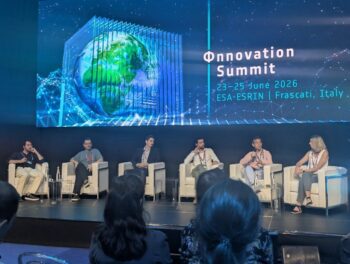
A few weeks ago, I was delighted to be part of an amazing fishbowl at the Phinnovation Summit organised by ESA Φ-lab Collaborative Innovation Network . Moderated by Felix Seidel and Nicola Melega, we talked about the advantages and constraints of applying AI in space with Simon Vellas, Edoardo Ferrante, Miguel Such Taboada, Laura Rogers and Roberto Del Prete.
Many subjects were addressed, and here are some of my main takeaways:
Onboard AI is not about replacing ground-based applications, but about enabling new use cases that are not possible without it. Usually, the goal is to improve:
– Selectivity: the amount of data that needs to be downlinked. When searching for vessels in the ocean, do you really need all these empty ocean patches?
– Reactivity: the time between when a satellite observes an event and when actionable information becomes available.
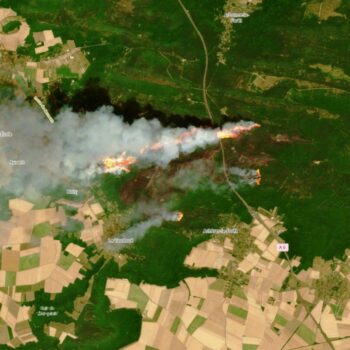
With major fires raging across France due to the heat waves, think about detecting the start of a fire from Space and delivering the information to firefighters as quickly as possible. The picture shows the Fontainebleau fire, captured by Sentinel-2B (L’incendie de la forêt de Fontainebleau vu par le satellite européen Sentinel-2B – Un autre regard sur la Terre).
The computing power available onboard is improving every year. I remember when we used only microcontrollers, now we have FPGAs and GPUs in space. As a result, the cost of implementing these algorithms decreases considerably. Smart satellites are not going to be a question of “if” but rather of “which algorithms”.
To my surprise, we talked a lot about the impact of raw imagery on the performance of AI models. This will be an important challenge in the future.
As part of my research over the last few years, I have been actively working to improve robustness and provide a useful solution for the community. We recently published a restoration model on the edge at CVPR, and we will release a paper on onboard transformers that are robust to raw imagery. Stay tuned!
My personal take: edge AI is one of the rare fields where we are working on model architecture to make models as efficient as possible, rather than aiming for ever-bigger models. We can still go from scratch, and that’s the fun of it!
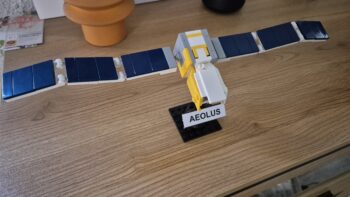
Thanks to Roberto Del Prete, and the ESA Φ-lab Collaborative Innovation Network for their invitation! (And thanks for the lego)